Kanosis Clarity™ Framework

The Kanosis Clarity™ Framework is built on the core operational pillars that have the greatest impact on organizational success, shaped by 15 years of cross-functional leadership and evidence-based research. We measure the behaviors and best practices within these pillars against your organization to generate clear readiness and performance metrics.

Discovery

Analysis

Strategy

Design

Implementation

Security & Testing

Monitoring

Optimization

The Kanosis Approach

Behaviors:
Kanosis evaluates organizations through a behavioral performance model which discovers how people’s habits, patterns, and day-to-day decisions translate into outcomes. Why focus on behavior? Research consistently shows that behaviors drive 60–70% of performance. Our own experience in practice reinforces the same conclusion: behaviors create outcomes.

We discover these behavioral patterns through our diagnostic assessments.

Performance Drivers:
What do we do with the behavioral insights? We align to proven, industry – agnostic drivers of performance. Kanosis organizes these into eight core operational pillars and have them measured based upon performance impact.

At our core, Kanosis places emphasis on people as the primary catalyst for organizational success.

Bringing It Together:
Kanosis measures behavioral patterns and grades those behaviors against operational performance drivers. When combined, these form the foundation of the Kanosis Clarity™ Framework.

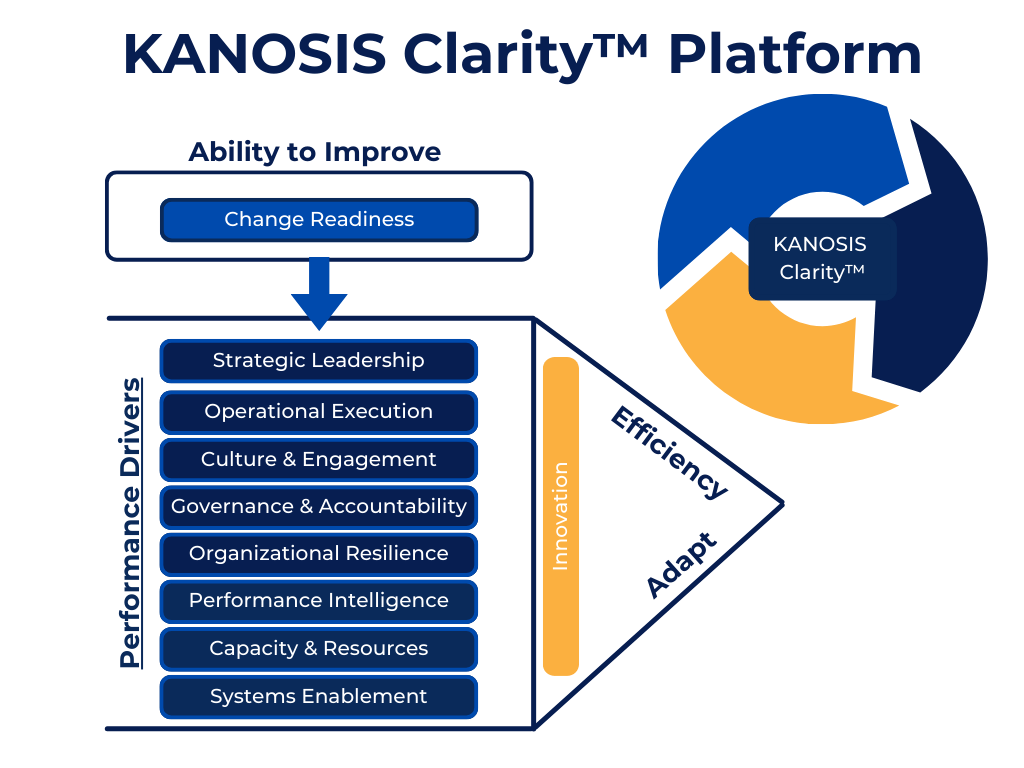
The Kanosis Clarity™ Framework Overview

Kanosis evaluates organizations through a structured model consisting of:

  • Change Readiness – your current ability to improve
  • Eight Core Operational Pillars – the drivers of performance
  • Innovation – your capability to evolve, adapt, and stay competitive

Together, these provide a complete picture of how your organization performs today and how well it can improve tomorrow.

There is no true “standard” for the most impactful driver of performance. The impact of each pillar is determined by the context of your organization, such as size, industry, structure, talent maturity, tenure, and more.

The Kanosis Clarity™ Framework goes deeper than surface-level “industry best practices.” It accounts for the unique characteristics of your organization before applying performance weights and generating recommendations. This ensures every insight is grounded in your reality, not a one-size-fits-all model.

The Kanosis Clarity™ Framework

Change Readiness

Change Readiness reflects an organization’s current capacity to improve. It draws from behavioral science and organizational psychology, integrating elements of the Transtheoretical Model of Change (TTM) and the COM-B Framework. These models are widely used in the medical and behavioral sciences and are adapted for business performance.

When combined, these measure:

  • Stage of Change (where the organization currently sits)
  • Capability for Change (skills, clarity, and support systems)
  • Opportunity for Change (environmental and structural enablers)
  • Motivation for Change (behavioral drivers and organizational energy)

Together, these factors determine whether behaviors will progress performance or restrict it, giving leaders a clear view of their organization’s readiness to move forward.

Innovation

Innovation is an organization’s ability to stay competitive by evolving with technology, market forces, and emerging opportunities. It answers a fundamental question: Is the organization actively trying to improve? Innovation acts as both a bridge into Change Readiness and a catalyst for transformation, whether sparked by a compelling value proposition or by a problem significant enough to demand change.

Execution

Execution demonstrates an organization’s ability to consistently convert strategy into action and results. It expresses how work moves across teams, how ownership is maintained, and how priorities are set. When execution is effective, momentum builds by reducing inefficiencies and keeping dependencies aligned.

Culture & Engagement:

Culture and Engagement is experienced through values and behaviors across the organization. They shape whether people feel motivated to contribute, safe to speak up, and connected to the work beyond formal roles. When culture and engagement are aligned, trust builds, discretionary effort increases, and alignment sustains without constant enforcement.

Leadership

Leadership defines the clarity, direction, and consistency that guide the organization’s daily actions. This pillar evaluates how well strategy is translated into goals, decisions, communication, and ownership. Strong leadership provides the strategic anchor that keeps teams focused, aligned, and accountable.

Governance

Governance establishes how decisions are made, ownership is established, and issues are resolved across the organization. It monitors whether accountability is clear, escalation is safe, and decisions move without confusion or delay. This allows leaders and teams to act with confidence, knowing how responsibility and authority are structured.

Adaptability & Resilience

An organization’s adaptability and resilience describe its ability to sustain performance as conditions change. They encompass how learning, recovery, and flexibility are built into the organization so performance does not degrade under pressure. When adaptability and resilience are prioritized, organizations renew themselves continuously rather than reacting only after disruption occurs.

Performance Intelligence

Performance Intelligence shapes how well an organization understands itself in operation. It highlights whether feedback, metrics, and insight meaningfully inform decisions and adjustments rather than lag behind them. When performance intelligence is functioning, leaders act earlier, recalibrate faster, and avoid learning only after outcomes are fixed.

Capacity

Capacity addresses how well demand, resources, and energy are balanced without eroding performance. It answers a practical question: how workloads, roles, and priorities are balanced within sustainable limits as pressure increases. When capacity is managed intentionally, organizations protect focus, avoid overload, and maintain execution under strain.

Systems & Tools

Systems and Tools comprise an organization’s infrastructure, processes, and technology. They focus on whether systems are reliable and fit for purpose without introducing unnecessary friction or complexity. Do they solve problems and accelerate execution, or do they slow the organization down?

Learn more

If you’d like to explore any topic in more depth, we regularly host educational sessions focused on specific areas of the framework. You can inquire about upcoming webinars or availability for lunch-and-learn discussions.